

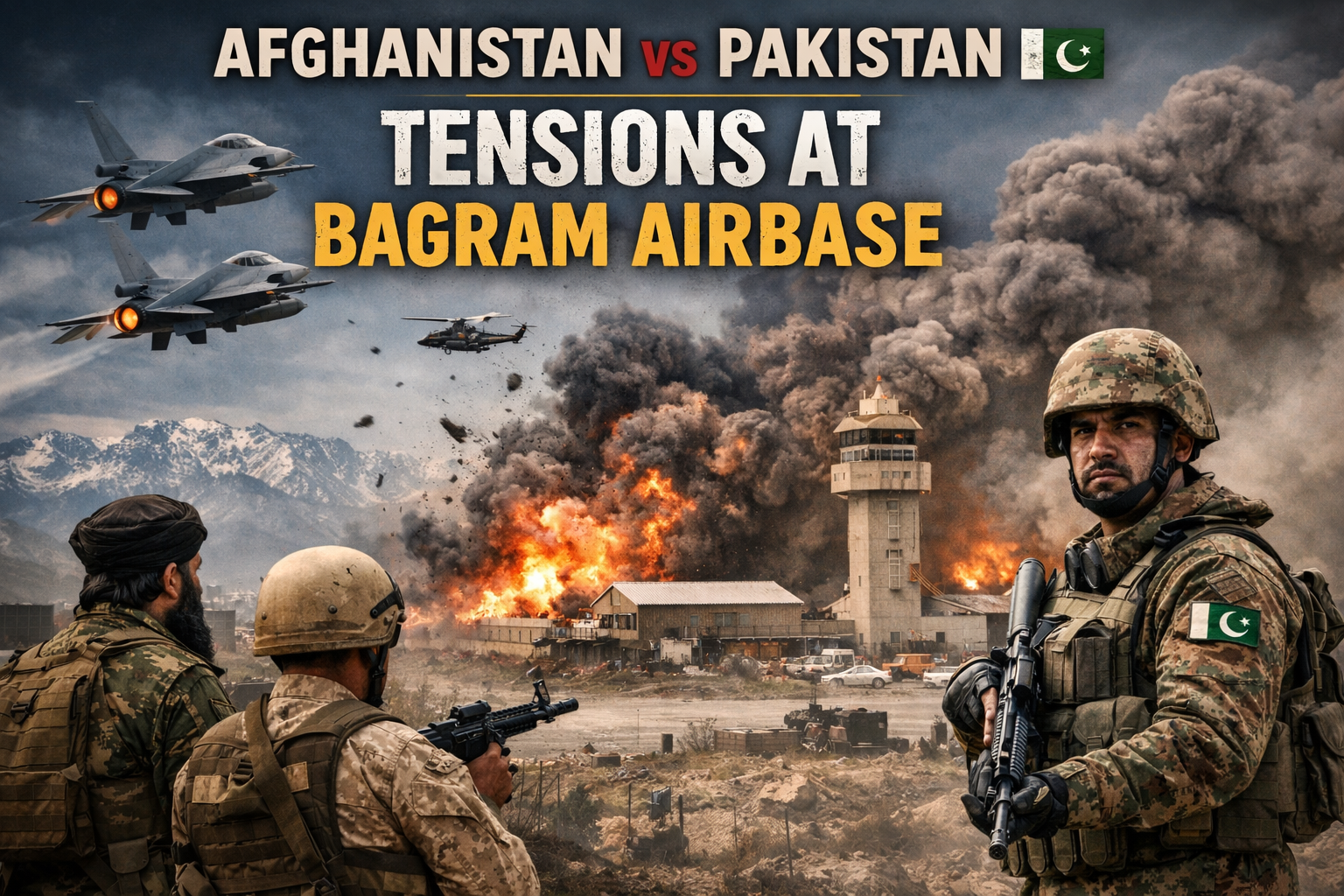
Rising hostilities between Afghanistan and Pakistan have once again brought regional security into sharp focus. The latest flashpoint centers on the historic Bagram Airbase, where Afghan authorities claim they prevented Pakistani airstrikes. The incident has intensified diplomatic strain and sparked serious concerns about broader instability in South Asia.
Afghanistan Pakistan Airstrikes at Bagram Airbase: What Happened?
According to officials from Afghanistan’s current administration, Pakistani fighter jets attempted to target Bagram Airbase, located north of Kabul. Afghan authorities stated that their air defense systems intercepted the threat before significant damage could occur.
Bagram Airbase remains one of the most strategically important military facilities in Afghanistan. Previously used by U.S. and NATO forces during the two-decade war, the base still holds symbolic and tactical value. Any attack on such a location naturally carries major political and military implications.
Pakistan has not confirmed striking the airbase directly. However, Islamabad maintains that it is conducting operations against militant groups that allegedly operate from Afghan territory and carry out attacks inside Pakistan.
Why Afghanistan Pakistan Airstrikes at Bagram Airbase Matter
The Afghanistan Pakistan airstrikes at Bagram Airbase are not an isolated development. Tensions between the two neighboring countries have been building for months due to cross-border militant activity.
Pakistan accuses Tehrik-i-Taliban Pakistan (TTP) of launching deadly attacks inside its territory while using safe havens across the Afghan border. Pakistani officials argue that targeted strikes are necessary to protect national security.
Afghanistan, on the other hand, strongly denies harboring anti-Pakistan militants. Afghan authorities claim that Pakistani operations violate their sovereignty and have reportedly resulted in civilian casualties.
This exchange of accusations has created a dangerous cycle of retaliation. With both sides increasing military pressure, the risk of escalation remains high.
Military and Strategic Implications
Bagram Airbase is not just another military installation. Its geographic location near Kabul gives it strategic significance. Any confirmed strike on such a base would signal a serious escalation in military confrontation.
Security analysts believe that even limited air operations could:
- Trigger retaliatory strikes
- Destabilize border provinces
- Increase refugee displacement
- Invite international diplomatic intervention
The Afghanistan Pakistan airstrikes at Bagram Airbase could reshape security calculations in the region if tensions continue to rise.
Civilian Concerns and Human Impact
Beyond military strategy, the human cost remains a pressing concern. Afghan officials claim that Pakistani strikes in border areas have resulted in civilian casualties. Pakistan denies deliberately targeting civilians and insists that operations focus solely on militant infrastructure.
Local communities near the border are reportedly facing fear, displacement, and uncertainty. Markets have been disrupted, schools temporarily closed, and cross-border trade slowed significantly.
Whenever air power is used in densely populated regions, even precision operations can carry unintended consequences. This is why international observers are urging restraint from both sides.
International Reaction and Diplomatic Efforts
Regional powers and international stakeholders are closely monitoring developments. Diplomatic channels are reportedly active, with efforts underway to prevent the situation from spiraling into open conflict.
South Asia already faces multiple security challenges. A prolonged confrontation between Afghanistan and Pakistan would further strain regional stability. The Afghanistan Pakistan airstrikes at Bagram Airbase have therefore drawn concern beyond just the two countries involved.
What Happens Next?
The future trajectory depends largely on political decisions made in Islamabad and Kabul. If dialogue resumes, tensions may gradually ease. However, if cross-border attacks continue, further military exchanges cannot be ruled out.
Both nations share a long and complicated border history. Lasting peace will require intelligence cooperation, border management reforms, and mutual trust — elements that have historically been difficult to sustain.
For now, the Afghanistan Pakistan airstrikes at Bagram Airbase serve as a reminder that unresolved security disputes can quickly escalate into larger confrontations.